 Tatiana Bazzichelli – Networking Art
The Book
|

“It’s The Crisis, Stupid!” (Panel at DEAF Festival)
DEAF Festival, Thursday 17 May 2012, 14-16.00.
Gouvernestraat 133, Rotterdam, NL
Title: It’s the Crisis, Stupid!
In the light of cuts in the cultural sphere, perhaps now is a good time to re-iterate Bill Clinton’s famous phrase “It’s the Economy, Stupid!” (itself a variant of the popular engineering principle “Keep it simple, Stupid!”). The panel will focus on the past, present and future of art in relation to a broken economy – and a crisis that deeply affects the production of art. How can art take place under these conditions? What can art indicate about the crisis? In a perverse way, does it present new opportunities for artists to achieve more autonomy over their production process? What are the alternative business models that emerge? The panel is interested broadly in business as artistic material for reinvention.
Introduction – Vicente Matallana
Speakers: Saul Albert, Christophe Bruno, Tatiana Bazzichelli, Giorgios Papadopoulus.
Respondents: Christian Ulrik Andersen/Geoff Cox/Søren Pold
Organised by LaAgencia and DARC, Aarhus University.
More info
reSource 001: Trial Crack

reSource event 001: Trial Crack
11-12 May, 2012
General Public, Schoenhauser Allee 167, 10435 Berlin (U2 Senefelder Platz)
The reSource transmedial culture berlin comes back after the transmediale festival with a two day programme under the name of “Trial Crack“, scheduled on May 11-12. On May 11 a collective discussion on logic of artistic production with cultural producers based in Berlin (15:00-19:00). On May 12 three different but conceptually linked discussions: Sustainable Disruption (13:00-14:50); Post Privacy (15:30-17:00) and Queer Shifts (17:30-19:00).
www.transmediale.de/content/resource-event-001-trial-crack
Read More
reSource for transmedial culture @ transmediale 2k+12 (résumé)

reSource for transmedial culture: Programme at transmediale 2k+12 (résumé by Tatiana Bazzichelli)
The reSource of transmediale culture (www.transmediale.de/resource) is a new initiative of transmediale festival that happens throughout the year in the city of Berlin, developing ongoing activities with decisive touchdowns at each festival. It is curated by Tatiana Bazzichelli, and works in collaboration with CTM/DISK, Kunstraum Kreuzberg /Bethanien and the Post-Media Lab of the Leuphana University Lüneburg, the three main institutional partners of the project.
The launch of reSource took place at transmediale 2012 (January 31-February 5, 2012) with a constellation of workshops, talks and performances distributed into five different sub-themes: reSource methods, reSource activism, reSource networks, reSource markets and reSource sex (read more here).
Realisation of the Programme
Coherently with the concept and methodology of developing reflection and exchange all year round, the programme of the reSource of transmedial culture started already in November 2011 co-organising an initiative at the Berlin University of the Arts. It was followed by the intense programme during transmediale festival, and later, it will go on producing some distributed initiatives which will lead to transmediale 2013.
DATA Event 51.0 in Dublin
When: February 16th 2012 18:30 – 20:30
Location: Studios One and Two, Science Gallery, Trinity College Dublin.
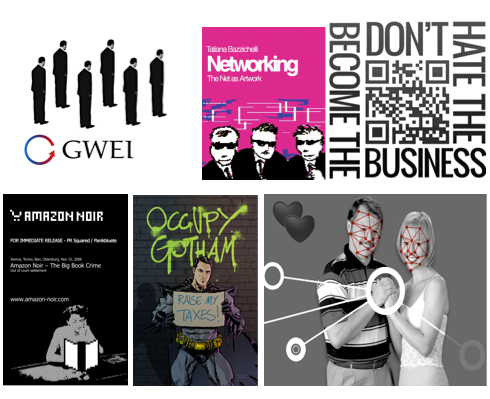
Data 51.0 brings together an international selection of media artists and theorists, to explore the links between activism, art, and business. Where open source, hactivism and media art generally are still presented as ideologically opposed to the logics of information capitalism, the reality is that many hackerspaces receive corporate funding, open source platforms and user-generated content form the basis for many commercially orientated applications and much of the dominant media art of today is to varying degrees reliant on the financial trajectories of technological R&D. Rather than denying this relationship or refusing to engage with the corporation, we want to ask how artists and activists might use their position in the market and their creative tools to critique, disrupt, or even potentially reshape economic spaces from within. Speakers: Editor of Neural Alessandro Ludovico, and artist Paolo Cirio, creators of Google Will Eat Itself, and Face to Facebook, and artist/theorist Tatiana Bazzichelli, author of Networking: The Net as Artwork.
This event is funded by the Centre for Telecommunications Research (CTVR) and Science Gallery, Trinity College Dublin.
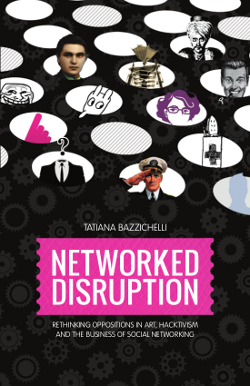
Ph.d-Defence: Networked Disruption. Rethinking Oppositions in Art, Hacktivism and the Business of Social Networking
 Ph.d-forsvar (Public Defence): Tatiana Bazzichelli
5. December 2011, 14:00 to 17:00
Det lille Auditorium, Incuba Science Park, Åbogade 15, Aarhus University
[Ph.d – Tatiana Bazzichelli]
Networked Disruption
Rethinking Oppositions in Art, Hacktivism and the Business of Social Networking
In connection with the submission of her PhD dissertation “Networked Disruption. Rethinking oppositions in art, hacktivism and the business of social networking” to the Faculty of Arts at Aarhus University for the award of a PhD degree in Information and Media Studies, Tatiana Bazzichelli will publicly defend her research in an open forum, 14-17 on Monday December 5, 2011, in Det lille Auditorium, Incuba Science Park, Åbogade 15, Aarhus University, Denmark.
The objective of this research is to rethink the meaning of oppositional practices in art, hacktivism and the business of social networking. By identifying the emerging contradictions within the current economical and political framework of Web 2.0, hacker and artistic practices are analysed through business instead of in opposition to it. Shedding light on the mutual interferences between networking participation and disruptive business innovation, this research explores the current transformation in political and technological criticism. After the emergence of Web 2.0, the critical framework of art and hacktivism has shifted from developing strategies of opposition to embarking on the art of disruption. Disruption becomes a two-way strategy in networking contexts, a practice to generate criticism, and a methodology to create business innovation.
Connecting together disruptive practices of networked art and hacking in California and in Europe, the author proposes a constellation of social networking projects that challenge the notion of power and hegemony, such as mail art, Neoism, The Church of the SubGenius, Luther Blissett, Anonymous, Anna Adamolo, Les Liens Invisibles, the Telekommunisten collective, The San Francisco Suicide Club, The Cacophony Society, the early Burning Man Festival, the NoiseBridge hackerspace, and many others.
Examining committee:
Senior Lecturer Olga Goriunova, Dept. of Applied Social Sciences, London Metropolitan University, United Kingdom;
Professor Franco Berardi, Accademia di Belle Arti, Carrara, Italy;
Associate Professor Geoff Cox, Dept. of Information and Media Studies, Aarhus University (chairman).
After the PhD degree there will be a reception in room 229, Nygaard Building, Finlandsgade 21, 8200 Aarhus N.
reSource for transmedial culture: Statement of interest
reSource for transmedial culture
Statement of interest & call for collaborations [download as pdf]


from: Vittore Baroni, "Real Corrispondence 6", 1981
The reSource is an initiative of transmediale – festival for art and digital culture, Berlin in collaboration with CTM/DISK GbR and Kunstraum Kreuzberg/Bethanien, on the search for further partners during 2012.
## reSource – A new initiative of the transmediale festival
The reSource for transmedial culture is a new framework for transmediale festival related projects that happen throughout the year in the city of Berlin. It is an initiative that extends into ongoing activities with decisive touchdowns at each festival. Within the aegis of facilitating collaboration and the sharing of resources and knowledge between the transmediale festival in Berlin and the local and translocal scene engaged with art and digital culture, the objective of the reSource for transmedial culture is to act as a link between the cultural production of art festivals and collaborative networks in the field of art and technology, hacktivism and politics.
This statement of interest is directed mainly to local and international artists, cultural producers, hackers, activists, and gender-situated communities active in the city of Berlin and in the broader field of net culture regionally and internationally, to co-develop experiences which invite exploration, experimentation and reflection. By generating a set of questions and issues which are addressed to local and translocal communities within (and beyond) digital cultural production, the main idea is to develop mutual exchanges of methodologies and knowledge, as well as project-space experiences, investigating new ways of forming a cultural public and producing a meta reflection on strategies of collaborative actions.
The launch of the reSource will take place at transmediale 2012 through different project disseminations such as workshops, talks and performances. It will in itself be an important feature of the 25th anniversary of the transmediale, looking into the future while acknowledging the importance of the festival as an accessible and dynamic forum for the translocal art scene as well as for interdisciplinary cultural producers and researchers.
The reSource launch at transmediale is anticipated by a beta-reSource event on November 16-18, 2011 at the Berlin University of the Arts (UdK) organised in partnership with the Digital Aesthetics Research Center (DARC) of Aarhus University and the Vilém Flusser Archive. After transmediale 2012, the reSource will extend its activity in collaboration with two main partners: CTM/DISK, proposing a series of open events held in the spring 2012, and Kunstraum Kreuzberg/Bethanien, organising a public event in August 2012, which will show the results of the first phase of collaboration and sharing within the context of the reSource for transmedial culture.
This statement of interest is thought as a call for collaborations to involve a number of additional projects and partners towards the creation of a distributed platform during 2012 and further, envisioning the festival form as a peer-production context of knowledge and research.
In/compatible Research Conference
in/compatible Research – Workshop/Conference
November 16–18, 2011
Berlin University of the Arts (UdK), Vilém Flusser Archive, Aula 110, 1st floor
Grunewaldstr. 2-5, 10823 Berlin – (U7 Kleistpark)
http://darc.imv.au.dk/incompatible/?page_id=18
International PhD workshop and conference, organised by the Digital Aesthetics Research Centre/Centre for Digital Urban Living (Aarhus University), in collaboration with the reSource for transmedial culture (transmediale festival, Berlin) and Vilém Flusser Archive, Universität der Künste, Berlin.
In the context of developing a platform for knowledge exchange, and research across the arts and sciences, transmediale festival (Berlin) and Digital Aesthetics Research Centre/Centre for Digital Urban Living (Aarhus University) have established a partnership to foster new forms of collaborative peer-review and knowledge dissemination. Departing from the theme of the upcoming transmediale festival in 2012: in/compatible, a PhD workshop and conference is taking place on November 16–18, at the Vilém Flusser Archive, Universität der Künste, Berlin.
This event addresses the theme of the transmediale festival in a number of ways: in/compatible interfaces, in/compatible methods, and in/compatible markets, focusing on the unresolved tensions in-between different technologies, their cultures of production and use, as well as the tensions between different approaches to contemporary media culture. The PhD workshop and the conference will lead to a collaborative peer-reviewed publication presented as part of the programme of the festival in 2012.
The actual workshop is restricted to the PhD students selected from an open call this summer. However, the conference programme and the plenary session will be open to the public.
Keynotes: Tiziana Terranova (it), Siegfried Zielinski (de).
Conference Participants: Christian Ulrik Andersen (dk), Tatiana Bazzichelli (it/de), Claudia Becker (de), Morten Breinbjerg (dk), Geoff Cox (uk/dk), Kristoffer Gansing (se/de), Andrew Murphie (au), Jussi Parikka (fi), Søren Pold (dk), Cornelia Sollfrank (de).
Artistic Interventions: Alberto de Campo (de), Dmytri Kleiner (ca/de) & the Telekommunisten Network.
PhD Workshop Participants: Cesar Baio (br/de), Zach Blas (usa), Jacob Gaboury (usa), Baruch Gottlieb (ca/de), Ioana Jucan (ro/usa), Tero Karppi (fi), Thomas Bjoernsten Kristensen (dk), Magnus Lawrie (uk), Aymeric Mansoux (fr/nl), Rosa Menkman (nl), Gabriel Menotti Gonring (br/uk), Anne Popiel (usa/de), Morten Riis (dk), Lasse Scherffig (de), Matthias Tarasiewicz (at), Marie Thompson (uk), Nina Wenhart (at), Carolin Wiedemann (de).
Getting Rough with Media: The ‘Right to Know’ Summit

- Time: November 5, 2011, 12:00-16:30
- Where: Theater Kikker Grote Zaal/Main Hall, Utrecht, NL.
curated by Stephen Kovats (Transmediale 2008-2011, McLuhan in Europe 2011)
Focusing on the ‘Right to Know’ the Summit invites discussion on how digital media engulfing our daily lives are now accessible in not only new but perhaps previously unimagined ways. Such accessibility also creates new forms of openness and malleability blurring the lines between the hack, the hoax and the objective. The public focus of the Net as being a broad ranging arena of information exchange moderated by proxies such as ICANN and dominated by enterprises incl. Google, Facebook and Amazon is once again shifting. Two decades into our life within the World Wide Web, a much wider and more diverse group of users has emerged using the Net as a central arena of critical socio-political activity.
The currently unfolding ‘Arab Spring’, as well as the victory of the Pirate Party in Berlin’s State elections, fuels forces that have the ability to create new forms of information visibility and data malleability. These major popular movements have radically influenced all sides and players in the rapidly evolving and seemingly completely unpredictable shifts in social and political orders. The recent case of the ‘unmasked’ fraudulent (or simply naive prankster) U.S-based blogger who purported to be a Syrian Lesbian rights activist moving to the fore of that country’s current revolt underscores the precarious level of blind trust mass media and digital society at large nonetheless still places on the power of ‘sincerity’ in net-based communication. Hacktivism itself, once the poetic domain of seemingly invisible forces, is becoming mainstream. Is there a danger that the rough, highly unstable edges of digital media and network practice, including political hacktivism, open source protocol design (i.e. Thimbl, DIY tools and apps) and evolving movements such as Sharism, will be ‘corporatised’? Where do these forces converge, and where does the opportunity lie to entrench the idealism of the Net’s ability to be the essential guarantor of expressive freedom and mobility? By supporting and embracing the rough edges of the media, keeping these in flux and critical, we have the historical opportunity to firmly guarantee, as an entire society, the Net’s primary strengths and characteristics: that of a truly open, unregulated and free tool of communication.
Featuring: Alejo Duque, Christopher Adams, Tatiana Bazzichelli, Sami Ben Gharbia, Alejandra Perez Nunez, Rui Guerra and Sunil Abraham. Introduced and moderated by Stephen Kovats, respondent Chris van der Heijden.