Networkingart artivism, hacktivism and social networking
  • scissors

    Ph.d-forsvar (Public Defence): Tatiana Bazzichelli
    5. December 2011, 14:00 to 17:00
    Det lille Auditorium, Incuba Science Park, Åbogade 15, Aarhus University
    [Ph.d - Tatiana Bazzichelli]

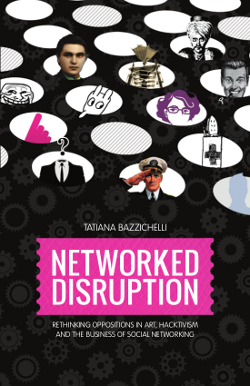
    Networked Disruption
    Rethinking Oppositions in Art, Hacktivism and the Business of Social Networking

    In connection with the submission of her PhD dissertation “Networked Disruption. Rethinking oppositions in art, hacktivism and the business of social networking” to the Faculty of Arts at Aarhus University for the award of a PhD degree in Information and Media Studies, Tatiana Bazzichelli will publicly defend her research in an open forum, 14-17 on Monday December 5, 2011, in Det lille Auditorium, Incuba Science Park, Åbogade 15, Aarhus University, Denmark.

    The objective of this research is to rethink the meaning of oppositional practices in art, hacktivism and the business of social networking. By identifying the emerging contradictions within the current economical and political framework of Web 2.0, hacker and artistic practices are analysed through business instead of in opposition to it. Shedding light on the mutual interferences between networking participation and disruptive business innovation, this research explores the current transformation in political and technological criticism. After the emergence of Web 2.0, the critical framework of art and hacktivism has shifted from developing strategies of opposition to embarking on the art of disruption. Disruption becomes a two-way strategy in networking contexts, a practice to generate criticism, and a methodology to create business innovation.

    Connecting together disruptive practices of networked art and hacking in California and in Europe, the author proposes a constellation of social networking projects that challenge the notion of power and hegemony, such as mail art, Neoism, The Church of the SubGenius, Luther Blissett, Anonymous, Anna Adamolo, Les Liens Invisibles, the Telekommunisten collective, The San Francisco Suicide Club, The Cacophony Society, the early Burning Man Festival, the NoiseBridge hackerspace, and many others.

    Examining committee:
    Senior Lecturer Olga Goriunova, Dept. of Applied Social Sciences, London Metropolitan University, United Kingdom;
    Professor Franco Berardi, Accademia di Belle Arti, Carrara, Italy;
    Associate Professor Geoff Cox, Dept. of Information and Media Studies, Aarhus University (chairman).

    After the PhD degree there will be a reception in room 229, Nygaard Building, Finlandsgade 21, 8200 Aarhus N.

    Tags: , , , , ,
  • scissors
    Panel, ISEA Istanbul, Monday, 19 September, 2011 – 09:00 – 10:30
    Sabaci University, Sabaci Center, Room 3, Istanbul, Turkey

    The panel investigates some of the interconnections between art, activism and business. “Don’t hate the media, become the media”, was one of the slogans of Indymedia. We are applying this critical hands-on perspective to the business framework.

    The panel investigates some of the interconnections between art, activism and business. “Don’t hate the media, become the media”, was one of the slogans of Indymedia. We are applying this critical hands-on perspective to the business framework. Presenters examine how artists, rather than refusing the market, are producing critical interventions from within. As the distinction between production and consumption appears to have collapsed, every interaction in the info-sphere seems to have become a business opportunity. Therefore, the creative intersections between business and art become a crucial territory for re-invention and the rewriting of symbolic and cultural codes, generating political actions or social hacks that use a deep level of irony, but also unexpected consequences. The tactics demonstrate the permeability of systems — that these can be reworked — and more so, that radical innovation requires modification of the prevailing business logic.

    The backdrop of the Istanbul Biennale makes a useful reference point here as one of the markers along with art fairs in general for the commodity exchange of artistic production. We are not suggesting these are new issues — as there are many examples of artists making interventions into the art market and alternatives to commodity exchange — but we aim to discuss some of the recent strategies that have emerged from a deep understanding of the net economy and its markets.

    The panel explores some of these contradictions: that on the one hand, there are alternative or disruptive business models that derive from the art scene, often as critical or activist interventions, but on the other how these practices can be easily co-opted by proprietary business logic. This is perhaps exemplified by the business idea of ‘disruption-innovation’, where disruption is considered to be a creative act that shifts the way a particular logic operates and thus presents newfound opportunities. Does this mean that well-meaning critical strategies of artists and activists are self-defeating? How do we develop disruptive business models that do not simply become new models for business that ultimately follow capitalist logic?

    We maintain there is nothing wrong with doing business as such.

    Chair: Tatiana Bazzichelli, Geoff Cox
    Presenters: Christian Ulrik Andersen & Søren Bro Pold
    Contributors: Dmytri Kleiner, Elanor Colleoni, Maya Balcioglu

    The occasion is also thought as launch of the project DisruptivBiz, a platform of research on the topics of Disruptive Art and Business curated by Tatiana Bazzichelli and Geoff Cox.

    More information

    Tags: , , ,
  • scissors

    On August 31, 2011, I handed-in my PhD dissertation (Department of Information and Media Studies, Aarhus University), which will be discussed at the beginning of December (date to be announced). The following is a short abstract of the contents.

    PhD Dissertation Abstract:

    Networked Disruption
    Rethinking Oppositions in Art, Hacktivism and the Business of Social Networking
    by Tatiana Bazzichelli

    Objective:
    The objective of this research is to rethink the meaning of critical and oppositional practices in art, hacktivism and the business of social networking. The aim is to analyse hacker and artistic practices through business instead of in opposition to it. By identifying the emerging contradictions within the current economical and political framework of Web 2.0, my aim is to reflect on the status of activist and hacker practices as well as those of artists in the new generation of social media (or so called Web 2.0 technologies), analysing the interferences between networking participation and disruptive business innovation.

    Hypothesis:
    My hypothesis is that mutual interferences between art, hacktivism and the business of social networking have changed the meaning and contexts of political and technological criticism. Hackers and artists have been active agents in business innovation, while at the same time also undermining business. After the emergence of Web 2.0, the critical framework of art and hacktivism has shifted from developing strategies of opposition to embarking on the art of disruption. Artists and hackers use disruptive techniques of networking within the framework of social media, opening up a critical perspective towards business to generate unpredictable feedback and unexpected reactions; business enterprises apply disruption as a form of innovation to create new markets and network values, which are often just as unpredictable. Disruption becomes a two-way strategy in networking contexts, a practice to generate criticism, and a methodology to create business innovation.

    Read the rest of this entry »

  • scissors

    Essay published in Italian in the book RomaEuropaFakeFactory, edited by C. Hendrickson, S. Iaconesi, O. Persico, F. Ruberti, L. Simeone, Derive Approdi Ed., Rome, Italy, 2010.

    English version: Tatiana Bazzichelli, Aarhus, May 2010

    0208interior

    In 1981, writing about the concept of ‘ethnographic surrealism’, James Clifford referred to Lautreamont’s definition of beauty: “The chance encounter on a dissecting table of a sewing machine and an umbrella” [1].

    James Clifford described the ethnographic attitude as ways of dismantle culture’s hierarchies and holistic truths. Cultural orders are substituted with unusual juxtapositions, decomposition of reality, fragments and unexpected combinations; the objective of research is not really seen in rendering the unfamiliar comprehensible as part of the ethnographic tradition wanted, but in making the familiar strange “by a continuous play of the familiar and the strange, of which ethnography and surrealism are two elements” [2] [3].

    Aesthetics that values fragments, and a methodology of revealing evident contradictions without solving them, but rather leaving them open to new interpretations, as a form of cultural criticism and a way to understand contemporary phenomena. This method, showing our present as a collage of incongruities which don’t just resolve in a dialectic of oppositions, give us input to think about future tactical strategies in the field of art and media.

    The present essay deals with the concept of social networking and with the development of folksonomies through social media platforms. It reflects on the status of artistic and activist practices in the Web 2.0 analyzing interferences between networking and business. I will start referring to the dialectical perspective ‘Ästhetisierung der Politik – Politisierung der Kunst’ (aesthetization of politics – politicization of art) by Walter Benjamin [4], in the present context used to describe the development of social networks as an aesthetic representation of social commons, and consequently, to analyze possible strategies of artistic and activist interventions in the social media. Another fragment of my analysis shows how the endless cycles of rebellion and transgression coexist with the development of business culture in Western society, breaking the juxtaposition between art as an aesthetic form of collective representation and art as a form of political intervention by a collectivity. I will show how, since the Avant-gardes, critical art and business have had evident signs of interconnection, especially in the frame of the collective representation of the masses. In conclusion, I will develop the concept of The Disruptive Art of Business as a form of artistic intervention within the business field of Web 2.0, where artists and activists, conscious of the pervasive presence of consumer culture in our daily life, react strategically and playfully from within. The essay ends suggesting possible strategies of artistic action, as a result of framing open contradictions without wanting to resolve them through an encompassing synthesis.

    Read the rest of this entry »

    Tags: , , , , , ,
  • scissors

    Panel hosted by DARC (Digital Aesthetics Research Centre, Aarhus University)
    Presenters: Christian Ulrik Andersen (DK), Tatiana Bazzichelli (IT/DK), Geoff Cox (UK/DK), and Les Liens Invisibles (IT).

    1bulb

    Share Festival, Turin, Italy. November 3, 2010. Regional Museum of Natural Science, Conference Hall, 2pm.

    The panel investigates some of the interconnections between art, activism and business. Presenters examine how artists, rather than refusing the market, are generating cultural Trojan horses — social hacks, or “smart errors” — producing critical interventions from within. As the distinction between production and consumption appears to have collapsed, every interaction in the info-sphere seems to be a business opportunity.

    The phrase “creative economy” is a perversion in this line of thinking. Therefore, the creative intersections between business and art become a crucial territory for re-invention and the rewriting of symbolic and cultural codes, generating political actions, attempts of social innovations, but also unexpected consequences and a deep level of irony. Errors or mistakes demonstrate the permeability of systems — that these can be reworked — and more so, that radical innovation requires modification of the prevailing business logic.
    We are not suggesting these are new issues — as there are many examples of artists making interventions into the art market and alternatives to commodity exchange — but we aim to discuss some of the recent strategies that have emerged from a deep understanding of the net economy and its markets. Examples derive from software development and net cultures, such as peer production, free culture initiatives, gift economies, extreme sharing networks or open source business models.

    Read the rest of this entry »

    Tags: , , , , ,
  • scissors
    “Coke Side of Life” advertising campaign

    “Coke Side of Life” advertising campaign (2009)

    Essay by Tatiana Bazzichelli: “If You Can’t Hack ‘em, Absorb ‘em or the Endless Dance of the Corporate Revolution”, published in Concept Store nr. 3, journal by Arnolfini Contemporary Art Gallery, Bristol, UK. Get the issue here. Get the PDF here. Read the full text below.

    What were once the values and philosophy of the hacker ethic are since some years the domain of many of the business companies which represent the development of Web 2.0 and contributed to create the notion of social media.

    According to Steven Levy, the first one to use the term hacker ethic as described in his book Hackers: Heroes of the Computer Revolution (1984), the hacker ethic was a “new way of life, with a philosophy, an ethic and a dream”.

    A philosophy, which had its own language and rules, and its own representative community, whose roots went back into the 1950s and 1960s, crossing the activity of the hackers at the Massachusetts Institute of Technology (MIT) and in the Seventies, the rise of the sharing computer culture in California (well represented by the Community Memory Project in Berkeley and the Homebrew Computer Club in Silicon Valley). Embracing the ideas of sharing, openness, decentralization, free access to computers, world improvement and the hand-on imperative (Levy, 1984) the hacker ethics has been a fertile imaginary for many European hackers as well, who started to connect through BBSes in the Eighties.

    Read the rest of this entry »

    Tags: , , , , , ,
  • scissors

    Free Beer by Superflex

    Free Beers by Superflex

    Last May 21st, I ran a seminar together with Geoff Cox on the intersections between art, business and activism, at Aarhus University.

    The seminar, as part of the DARC, Digital Aesthetics Research Center meetings, addressed the new forms of business that emerge from the uses of social media and critical arts practices, models that offer new insights into exploitation and even new ways of creating value. Geoff and I opened  the discussion on how best to translate these topics  into future research projects (e.g. in collaboration with SNYK), while presenting a range of different concepts. The research seminar was scheduled for Friday the 21st of May, 10-12, Aarhus University.
    The title “Disruptive Art of Business” derives from a paper I wrote for an upcoming book, as part of my PhD Research investigation on Networking 2.0 (read more about the meaning of disruptive technology here). Another of my articles on art, business and social hacking is published by Concept Store Journal nr.3 (Arnolfini Gallery, Bristol), and it is also online here.

    Key concepts: crisis of value, debt economies, alternative models (eg. music industry), donations based models, open source business, P2P (see Peer to Peer Foundation for instance), non-monetarised exchange and the gift, free software development, waged and unwaged labour, transformation of the institution, new forms of organization that take cue from networks culture (Organized Networks), buzz words, like sustainability, recuperation and tactical media strategies, disruptive art.

    Read the rest of this entry »

    Tags: , , ,
  • scissors

    newcastle-gb560

    Venue: Culture Lab, Space 4/5, Newcastle, UK
    Time/Date:
    9th March 2010 – 10th March 2010, 09:00 – 17:00
    AHRC funded Collaborative Research

    I am leaving for Newcastle to attend the event: Creative Digital Media Research Practice: Production Through Exhibition. It is an AHRC funded Collaborative Research Training project on digital media, art research and curating. I’ll be part of a a panel on Do It Yourself research practice (moderated by Lalya Gaye) and I am going to present the topics of my current research at Aarhus University, Networking 2.0, An aesthetic, technological and social critique of collective art. I will also share my methodological approach, which is inspired by the Ethnographic Surrealism of James Clifford, (1981) and present my current investigation, which combines a multi-semiotic approach, and an empirical “intermedia” of networking practices, hacker and activist strategies.

    Here is a description of the event – my talk is scheduled on the afternoon of March 10, Culture Lab, Newcastle.

    Read the rest of this entry »

    Tags: , , ,